Philippine Business Service Provider

Philippines is a growing outsourcing country. Business industry trusted Philippines for the offsourcing business. United States and European countries trust the Philippines for managing the business outsourcing company. It is one of the leading businesses in the country today. Some of the Philippine regions that become a leading business outsourcing company are located in Manila, Cebu and Davao. 

Business outsourcing company becomes widely known world-wide because the Philippine business service provider here in the country is worthy to trust for. It provides fast and reliable services to its client. Every client is respected and treated well. It is one of the ideal Filipino culture and custom, being hospitable to visitor and to anybody. This friendly attitude of Filipinos becomes an asset for providing a good client business relationship and rank also the Philippines as a good Philippine business service provider. 

The outsourcing business is contract based business which caters different outsourcing businesses that based on the client needs. The business outsourcing company performed all the client needs such as website designing and management, client purchasing and query services, and others outsource services. The business outsourcing company makes partnership into established companies to make its company rank up and become a leading a searchable company.

These services become known because it reduces training and hiring expenses. The company reduces operating and capital expenses because the company does not have to hire expert people to do the online marketing and customer service agents. The business outsourcing company will provide all these staffing and operating services. It becomes a cost effective and good client services relationship for both companies. 

Some of the Implications are the following:
  1.  Management processes is easy through the use of the modern technological gadgets that is used in online management.
  2.  Reliable Quality of service is process through reliable customer satisfaction questioner.
  3. Language Skills. Filipino is a good linguist that articulate and proficient in English language.
  4. Security. Fraud is prevalent if the company chooses is not trustworthy and unreliable business outsourcing company. Avail outsourcing services from the trusted and reliable Philippine business service provider.

Movie Critic on Movies Showing Future Technology

Surrogates is a fictional movie about robots and human interaction. It is played by Bruce Willis as the main actor of the movie. To give an overview about the movie; the robots replaced the real man. They are controlled by human being through the use of a device that commands the machine to do the things usually human does like partying, working, guarding, cooking and etc. The robots are called surrogates. The movie is emphasizing about synthesizing humanity. The technological advancement showed in the film is very amazing. The modified human hides the disability of a man through making a mere representation of a perfect person he wants to be. The movie shows how a man gains confidence by making himself as perfect as what the world perceives a perfect being, which is not a good thing because it’s living on the shadow of somebody else. It is one of the negative effects of having a world that is so empowered with technology – being too relying on its work thus human tends to forget his true self.

The surrogates’ faces were made perfectly flawless and beautiful which makes the woman’s beauty surreal and is more likely a living puppet – emotionless and pale. The true beauty of a woman is not solely shown on a flawless skin or perfect facial features instead it could be found also on her personality and even simple acts like smiling.

On the contrary, though living like a surrogate is living in lies, when there would come a time that there would be war, the surrogates would replace man’s role on the battlefield. No more lives will go to waste. When a surrogate would be destroyed during the war, it will be replaced there and then.

Understanding man’s obsession of perfectness becomes the reason of his weakness. The surrogate makes the body rotten and weakling and it also invalidate the significance of man’s existence and it is as well an act of disobeying the natural law and philosophy of human life. When this event may come to reality, it will make the world dull, emotionless and machine-dependent. People will care no more about self-improvement, social relationship and spiritual devotion because they felt that they had achieves their perception of being perfect. The perfectness and flawlessness which the machines give to the working life cycle blinded the man his true purpose of living and being a living creation. The machine becomes the man’s representation of him which is living in fraud. The man is totally looking to be perfect in all aspects but always forgets that the best thing in life is having shortcomings and overcome them than having none. Life would be boring and not worth living without someone to love, to care and to live with, it is so surreal as if merely manipulated.

The Fifth Element is the movie played by Bruce Willis and Mila Jovovich. This movie is about extermination of all life forms in Earth. The Fifth Element is the light or the savior of mankind is a girl who possesses the ultimate power to stop the extermination. The movie involves aliens- the good and the bad one. The movie’s relationship about future technology is somewhat beyond today’s discoveries. Alien’s nowadays is considered fictional because their existence is not yet proven. The special effects in end part is very superficial and beyond the truth. Sorcery powers are not a science based discoveries and teachings.

The mechanical machineries and high technology advancements supported in the movie is very good, I like the life reviving machine system the most. The reviving machine would be an amazing discovery if it is really exist. All lives can be restored as long as there’s a lived piece of living cell of your remains. The machine rapidly restructuring perfectly the bones, then body cells and body tissues, and make the organs and muscles, and the most breath-taking is restoring the life. Life restoring is like modern God way process of making man. This life reviving phenomenon is a mere fiction and impossible. Machines cannot regenerate cells through one’s remains. If this would happen in reality, man’s life never ending life or immortality is achieved at last (just if ever). If this will be proven it will destroy the natural world balance and all living forms will become an experimental avenue of man’s greatest discovery. When equilibrium is lost catastrophe will prevail. Significance of one’s life will be no more.

Another mind-boggling technology featured in the movie is the flying car. The sky becomes the super highways of the world. While it is really wonderful of having a flying car, well I know it is near possible because of the air vehicle concept.

All these things is created because of man’s ultimate ambition of having a never-ending life that is impossible because the life that is lost will cannot be restored nor created.

The people created marvelous spaceship, fantastic flying cars and greatly amazing airplanes that flying from planet-to-planet tour.

Comparing both movies it simply tells that technological advancement is aiming towards this fictional world. Both movies show the people interest of to having a perfect life and perfect world. People continually search and discovery things to achieve this high tech life which is Impossible for now but we don’t know, this might or not be happened no one can tell.

Future IT Professional Contribution in the Society

As a future IT professional, what do you think will be your contributions for the development of technology based on what you learned from college? Define each and state its implications towards our IT society and industry.

Being a future IT Professional what can be my contributions for the development will be the following:

1. To be a good IT consultant. Based on what I’ve learned about career that an IT professional can have is becoming an IT consultant. I think being a good one would be a great help to the community in the sense that business nowadays is in IT development. I can give them good advice what the business is needed and what it can do more through using a better and suitable technology for them.

2. To be a good team leader or project manager. Being a good leader means being a good follower which most of the time is not that easy to follow because of being egoistic of a man. This is hard to gain but one’s it comes to your blood stream it would probably a good help for development to whole project as well as being a better person.

3. Becoming a creative and adoptive IT professional. Becoming a creative and adoptive in such a way that knowing to use the full blast of the technology based on the resources that are available. Even making creative design for graphical and animation aspects, while being adoptive on the free and available software that can help make improvements. In simple term being innovative in improvising IT enhancements.

4. Being a good follower. Being a good follower, I mean here is to know how to follow standard for compatibility and accessibility purposes. I also emphasizing here following what’s new in the IT world to make you compatible on what is the latest trends, strategies and process, always updating oneself.

5. Becoming a good communicator. Communicating with clients is a crucial part in IT business. You have to give clearer view on how importance is your products to be used in their companies. You have to convince them in the way that you have to make them understand its importance, and talking to clients is a very tough job.

All these are what I think I can probably my contributions in IT world.

Why use technology

Man is technology independent, almost all time people use technology. The work of people comes easy and light through the use in technology. People now can navigate around the world through land, seas and air. People can communicate people around the world and do understand each other’s differences- in races, language and culture is never an issue today, this is through using media that shows and teaches everything one need to know. Even synthesizing humanity is continuously being studied and developed; it is gradually improving and doing fine.

Reasons why use technology as well as the field where it is involved.


Technology Into Schools

1. Support Thinking Processes

Teachers believed on having computer-based technologies could provide support for thinking processes. And it is joyfully supported by student because problem-solving skills are being developed while having fun. Teaching strategies with the use of technology becomes effective and retain more than usual and traditional way. Students are not pressured in focusing to study because the instructional software caught student attention through the graphical and simulation effect the software provide. It also develops their visual and graphical skills as well as logical and analytical thinking skills through educational games and other software learning tools.

2. Simulate motivation and Self-esteem

Through technology student can find counsel and friends in social networking sites. In here, students can have someone to listen and understand one other; everyone can ask support anytime and anywhere. Aside from networking sites, there is an also video player site that showcases on self-motivation videos that explains about life and motivates viewer.

Through either personal experience or a review of the literature, many innovators perceived the dramatic effects that technology can have on students' interest in class activities and their sense of their own capabilities.

3. Prepare Students for the Future

Through the technology student is given an idea what the future looks like. Surfing the internet and even through television and radio broadcasting it tells the economy stability and newest trends of the world. All these, prepare the student what the course to the take and what job the world needed. So students can prepare ahead about what to expect in the future.

4. 4. Explore the technology capability

Nowadays technology vulnerability is pretty obvious to anyone. Anybody can explore the full strength of the technology. Everyone can have a chance to experiment and develop new things using the basic information of technology formation and foundation. Technology is open to everyone.

Technology in Sport

Sport is prone to human error. Why can I say this? It is because some violation can’t be seen by the referee due to some circumstance like blocking the sight. This common error is obvious in the basketball and other more game. In order to recuperate the problem using cctv camera and other surveillance gadgets can reduce the error and maximize the full and equal performance of the players.

Technology in Entertainment

Entertainment uses technology to make animation and graphical effects that makes the entertainment more effective and eye catching. It help imagination can travel widely and make impossible things possible through animation. It also showcases informative and inspiring entertainment.

Technology in medicine

The use of technology in medical field is very prevalent from time to time new technology in saving life through the use o technology in the field of medicine help to save life. Many medicinal technology procedure help prolong life and cure severe diseases that is a very good and useful thing technology help improving life.

Technology in daily life

Almost all the time, we sometimes don’t mind it. We use simple and complicated machines in daily basis.

Sad2_assignment1

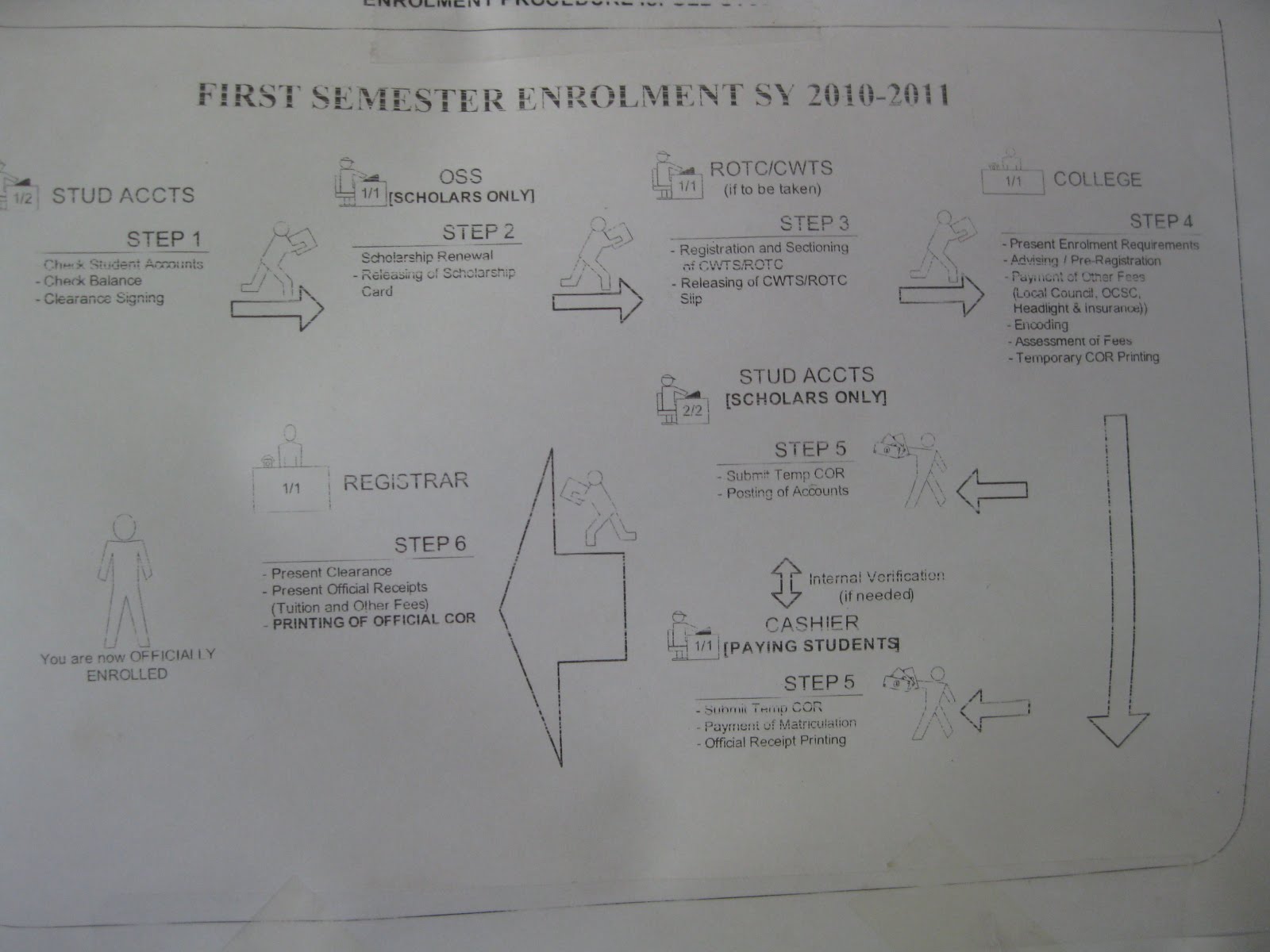
Assuming you were tapped by the university president to evaluate the new enrollment system implemented this semester, enumerate your observations/comments and suggest possible areas and ways where improvements can be made. Your observations/suggestions should be properly validated with facts and literatures...(you may start with the diagrams posted in the strategic locations of the university)... (1000words)


Enrollment system of OLD Student of USeP.
1. first is Paying of fees (Local Council fee, Obrero Campus Student Council fee, collegiate headlight fee and Insurance),
2. second (For scholars) Validate scholarship at the Office of Student Services,
3. third go to your college adviser, submit or present all necessary documents, and secure a Pre-Registration form,
4. fourth Fill up the Pre-Registration form and have your adviser to sign it,
5. fifth submit the Pre-Registration form to the encoder and secure Certificate of Registration,
6. sixth (For scholars) Verify student accounts at the bookkeeper. (For non-scholars) Pay tuition fee at the cashier,
7. seventh complete enrolment by getting stamped “Officially Enrolled” at the Registrar,
8. lastly validating the library card.

For freshmen and new students :


1. first go to UGTO and fill up student records,
2. second paying of fees (IC Local Council fee, Obrero Campus Student Council fee, collegiate headlight fee and Insurance),
3. third For scholars) Apply for a scholarship at the Office Student Services, Enroll in ROTC or CWTS,
4. fourth go to your college adviser, submit or present all necessary documents, and secure a Pre-Registration form,
5. fifth filled up the Pre-Registration form with the sign of the adviser,
6. sixth submit the Pre-Registration form to the encoder and secure Certificate of Registration,
7. seventh (For scholars) Verify student accounts at the bookkeeper. (For non-scholars) Pay tuition fee at the cashier,
8. eighth submit all necessary documents/requirements and complete enrolment by getting stamped “Officially Enrolled” at the Registrar,
9. ninth apply for a library card.
Comment on the picture:

The flowchart as you can see, it display the process but the way the figures being presented there are some minor flaws to re-check and fix.

1. The arrows are not uniform; they are in different sizes which is somewhat ambiguous for we have learned that symbols in flowchart have different meaning. Likewise, different sizes means having a different meaning.
2. There are so many actors which are unnecessary.

Suggestion:
1. Use a uniform arrow.
2. Use only actors that illustrate the appropriate individual.


All universities have a common enrollment system, the students must have to fill-up the subjects to enroll and have it encoded, and pay for all and any enrollment fees, but the difference and distinct between the USeP and other universities is the practice of implementing the enrollment system. Here at USeP, enrollment system for us is really a big burden for it lapses to two or more days before you will get admitted. How come? In some other schools enrolling yourself is a just a piece of cake but in USeP it seems as punishment. Is it a payment for a low tuition fee? It is actually not the intention of the university but they are so blind to see what the problem is and how to solve it. Here in USeP having an unorganized enrollment system is common view or scenario, so it might be the reason why until now it still becomes irresolvable issue.
Admission in USeP is really irritating to everyone before and even now. When I was in first year, I really shocked how chaotic, messy and disorganized the enrollment was. You have to line yourself in every transaction and the line is really very very long, and being a first year I am so blind about what was going on. I kept on asking what next where I can find those offices. It is irritating knowing that you don’t know things and having numerous students fall in line for each transaction. The most annoying part in the enrollment is those students who are noisy complaining and gossiping which pissed off the staff and people who are catering the services. So when both clash it’s become another reason for the delay. On the other hand, the hotness adds up the infuriating condition of the crowd.


That was before but now it still the same as before, improvement is really hard to determine. I was happy when they said that there is a new enrollment system for USeP. That time I thought the problem about the enrollment would be addressed now, but still processing the enrollment takes a day or more. Change there are saying and implemented seems so useless. The changes I see now are the following:

 New, bigger and nice registrar’s office.
 New computers in the registrar’s office.
 New Chairs in front of cashier’s and registrar’s office.
 Tarpaulins and pamphlets are posted in the wall about the enrollment process.
 The registrar gives the final COR.
 New Integrated Enrollment System .

My Suggestions are the following:
1. In my own perception the reason on the delays of enrollment is having much process that can be combined or merged into one transaction, to help student line no less than two transactions.
How to do this?
“Pictures”
1. I want to suggest that instead of having an advising during enrollment why not doing it after releasing of grade. In part of the student as earlier you know your standing is easier to accept. In this situation student can decide to go on or not. While in part of the adviser, he can advise thoroughly the student what proper action to do and give a relevant possible suggestion at the same time student can also have a thorough understanding and view clear what the best thing to do.
2. I suggest that aside on the respective colleges have the encoded of subject, why not doing it in the cashier area.
3. We can observe that cashier have the heavier job, so I suggest that additional staff is recommended for every college.
4. All student fees would be payable only in the cashier, through this student will only pay fees in just one place and it will be written directly in the COR.
5. The student can immediately process the validation of ID as well as stamping on the COR and receiving student clearance be easy and less hassle.
6. After doing so, the student can now get his library card ID be validated immediately.
All of this suggestion is based on my point of view.

Additional inputs:
Actually this steps of evaluation I found out on the entry on the past sad2 student her name is riza eve gador in her entry on their sad2 subject assignment 2. After reading her entry I am awaken that I must not only focusing on the physical aspect on evaluating the enrollment system cause I know that involve the currently system being use. I must involve the database but honestly I know nothing about the database of the school. So I will present the following things to consider on how to evaluate the database. According to her, she didn’t know who the author of this article is, because she had read it on the notepad. The article tackles about “What to look for in a Database System”.


1. Does the system appear easy to use?

Assuming you received a demo disk or watched a product demonstration, you should be able to get a feel for how to use the system. Are the instructions on the screens easy to understand? Are there clear menu selections? Is there a logical flow of steps or processes to follow? Can you use the mouse to give instructions or move from one screen to another? Are the instructions written in English as opposed to "computer-ese"? These are a few of the things to look for in evaluating how user-friendly the system is.

2. Does the system have adequate installation and reference documentation?

Will you be able to install the system yourself or will the vendor provide this service? Are there adequate, clearly written instructions provided? Is there user or reference material included with the software? If possible ask to see written documentation before you purchase.

3. Is the database relational?

A relational database (as opposed to a flat file) means you can have multiple jobs in process at the same time, while keeping track of each one. For example, with a relational database, you are able to have dozens of active jobs, each at a different stage. At any time, you can locate a particular job, identify the respondents and the client associated with it, and edit information pertaining to the job. And even after the job is closed, you can revisit that job and identify all the details of the job, including the respondents who participated in it. A relational database has obvious advantages over a flat file.

4. Does the system have features that will save you time and money?

Look for the extra features that can boost your productivity. Mailing labels and reports are useful. Pre-formatted recruiting lists and/or sign-in sheets will save you time. Client invoicing is a handy option. If you can identify at least one feature that will save you a significant amount of time that database system will probably be a sound investment.

5. Is the database written in an application that is widely used and has a good reputation?

There are dozens of database applications on the market today. They vary tremendously in cost, ease of use, and popularity. Some database applications have very specialized uses. If the database system you purchase is written in one of the more popular applications (e.g. Access, Paradox, SQL Server), you will gain several advantages. First, your vendor or developer will have better access to technical support. This will benefit both of you if there's a bug or problem your developer has not previously encountered. Second, it will be easier for you to exchange data with other applications such as a word processing program or spreadsheet. Finally, using a popular application will give you peace of mind if you have an emergency and your files need to be recovered or restored. You are more likely to find help locally if your database system is written in one of the more popular applications.

6. Can the system import and export data to and from other applications?

Suppose you acquire a computerized list of respondents, along with their addresses, dates of birth, and other demographic information. Rather than manually entering each record into your database system, you might prefer to import the information directly into your database. A system that imports and exports data in the form of text, spreadsheets, for these purposes can save hours of data entry time.

All the mentioned above is a great help when evaluating a database system this is also helpful in our SAD subject.

Relationship Between IS Plan and Business Plan

Management Information System (MIS) requires understanding about the subject contents and components, and its essentiality in the society, and how it works and affects human life. Starting our journey about the MIS environment, we must first know what the stuffs we must consider in introducing MIS are Business Industries and Information Technology (IS) itself, and how they are correlate each other. This first step will give us the idea that IS is one of the elements in the business world, that is why as an IT students we have to adopt and considered the business industry, and how to link IT into its prospect industry. Based on the learning’s that I’ve learned in this past few years of studying as an IT students, I’ve known that IT is an helping tool for the business industry to progress and prosper .
All of the success in the business and in the field of technology is not by luck but with the proper, appropriate and correct management and planning. But as of this moment we will tackle about essentiality of having a good plan in both the business and in the Information Systems area. When we talks about planning it is a crucial task. Its because of some factors to be considered such as long time for hardware delivery, the difficulty of software development and the preparation needed for training and implementation have all demanded advance planning. This planning task has been primarily technical, specifically focuses on hardware and software and its relationship into the business industry. It is a preparation of one business or one system how to improve one's organization for the days or years to come. It is trying to respond in the changes and challenges that blocks the way of success. It is strategical approach of new ideas, new techniques, new business strategies and new systems, which intentionally gives a positive impacts in the business and organizations. For instance, the business makes a plan first before implementing something, like purchasing the new system for the new accounting system. Before the system may come in to reality it must to pass through different and formal process, the request must be done in the sequential and documentary way, like stating the purpose, the benefits, people involve , cost and many more to consider just to be approved. And for some like small business before they have a new machine it would be studied first if the cost would be worth to take the risk, and become the cause of the delay. After the evaluation if it really not approved, the owner would ask for any alternative that is low cost but functional though not so good in quality and performance as long as it fits on the budget, they will go for it, but still before it come to reality it passed to a long process and studied well by all concern. What I want to say is that planning done properly to find its effectiveness and usefulness in any organization. The way to success is the proper way f planning , predicting the problems that may result destruction and failure of the organization by having strategical solutions and plan to fight it up.
However, to elaborate and make a clearer view about the topic, we must first define and expose its real meaning that define by the author.
-Information System (IS) Today, James O'Brien,2003.McGraw Hill Company Inc.,
Information System can be any organized combination of people, hardware, software, communication networks and data resources that collects, transforms and disseminate information in an organization. While Business plan is a formal statement of a set of business goals, the reason why they are believed attainable and the plan reaching those goals.
-www.wikipedia.com
Business is first established than Information Technology (IT). Filipino started trading through barter system until such time that we learned to use for business transaction. In regards on the widely spread of business throughout the globe, managing information files was done manually until during 1970’s. In part of this year, information workers exceeded 50% of the work force. This is due of bigger and longer the company operates the larger documentation files stored and processed, although in the late 1950’s and early 1960’s. “IT” hardly exist still its compatibility and usability was not yet disseminated well. They were started using computer for data processing applications, their impact was comparatively modest. This was all because this change could not come too quickly to satisfy user needs. But, still people tried so hard to make things possible in which after late 1960’s, Information work grew rapidly. Through this responds we now make use IT resources effectively and efficiently.
Nowadays, proper designation and implementation of the Information Systems (IS) will become a big factor to the business prosperity. That is why Business plan correlates with Information System Plan.
The both elements are very important and specials in an organization. With the aid of this two, the business will prosper. Proper handling of information system will help in decision making while having a good business plan that will lead you where your business is going, it will be your map in your journey to successful business. It might be the road to taken be not so smooth but having a good business plan to address and overcome the circumstances that comes along the way. That is the main purpose of the planning, planning for the future.

How does IS help the business world?
1. It help in company's decision-making. Because it gives an accurate, timely and usable output of all financial statement of account and other financial reports and ledger. It also provide a more comprehensive graph that identifies the growth and downfall of the business operations and profit. The graph also see to it what period is the peak season and when it is not, when and where to produce and reproduce a product.
2. It makes the nature of job simplified and categories into specific job description. With regards on the job specification in the company in regards to Information System, it makes the nature of job for one personnel to furnish a more precise and a better performance in regards to its job, it will minimize multi-tasking. This will keep time the personnel to focus in one specific job.
3. Making use of latest technological trends. The newest technology you have the coolest, this is the motto of all the techie people says but in business not at all times, why? Is is because in the business world making use or purchasing new system would be very costly and complicated. Acquiring new system needs a proper preparation and planning. But we should not regard the facts that a having new systems will help addressing the company problems when regards to company transactions.
Components of IS Plan
1. Equipment 6. Financial Projections
2. Software System 7. Staff Development
3. Development Projects 8. Alternative Technology Projections
4. Database Plans 9. Organizational Design
5. Telecommunications Plan 10. Alternative Business Projection

Differentiate Information System Plan into Business Plan
Business plan has been identified as a summary of how a business owner, manager, or entrepreneur intends to organize an entrepreneurial endeavor and implement activities necessary and sufficient for the venture to succeed. Business plan is being used as Venture capital, Public offerings, while within corporations it includes Fundraising, Total quality management, Management by objective and Strategic planning.
When we talk about Venture Capital it denotes about two things: Business plan contests which provide a way for venture capitals to find promising projects while venture capital assessment of business plans focus on qualitative factors such as team. This entire collective investment scheme is a way of investing money with others to participate in a wider range of investments than feasible for most individual investors, and to share the costs and benefits of doing so. However, venture capital fund refers to a pooled investment vehicle which means that, primarily invests the financial capital of third-party investors in enterprises that are too risky for the standard capital markets or bank loans. Other capitalist are invested into small and less mature companies but expect so much in return, this happen because its one way of taking over the management or another way around but with purely the reason on investments return. Furthermore, venture capital investments are generally made as cash in exchange for shares in the invested company. It is typical for venture capital investors to identify and back companies in high technology industries such as biotechnology and ICT (information and communication technology).
Aside from being a business-minded you have a responsibility to have a public offerings which makes potential investors evaluation on perspectives of issuing company. IT is having informed the public of the issues that mainly concern on the people's involvement. Example of it is fund raising is the primary purpose for many business plans, since they are related to the inherent probable success/failure of the company risk. It fails when the number of availing the service are availed the fund raising but the return of investment is not sufficient nor never achieve in their target sales this is means company lose which mean that the strategy is not so effective. Total quality management

Total quality management (TQM) is a business management strategy aimed at embedding awareness of quality in all organizational processes. TQM has been widely used in manufacturing, education, call centers, government, and service industries, as well as NASA space and science programs. The basis of TQM is to reduce the errors produced during the manufacturing or service process, increase customer satisfaction, streamline supply chain management, aim for modernization of equipment and ensure workers have the highest level of training. Less error means near into perfection and so closes in to the peak of success and satisfaction.

Information System Plan corporate with three Framework:
1. Stage of Growth
Identification and initial investment it is somewhat the beginning use of the new system. Experimentation and learning will follow. All of this steps help the corporation categorizing the stages of growth, how the business grow.

2. Critical Success Factors (CSF) is the term for an element that is necessary for an organization or project to achieve its mission. It is a critical factor or activity required for ensuring the success of your business. The term was initially used in the world of data analysis, and business analysis. For example, a CSF for a successful Information Technology (IT) project is user involvement.
3. Business Systems Planning

Business System Planning (BSP)

It is another popular methodology for system planning which developed and marketed by IBM. The basic philosophy of BSP is that data is a corporate resource. As such, it should be managed from an overall organizational view point, that it can be best serve the organization’s objectives and support its decision making activities.

The steps in the BSP study

1. Gaining commitment. Commitment is actually having people willing to commit themselves for the project they are the: a study sponsor (who are the top executive of the organization), team leader (one of the top executive who is assigned to lead the project) and members of the team. The team leader and members commits themselves to build the project. The final study recommendation would be presented into study sponsor, for further reviews and ask approval to proceed.

2. Preparing for the Study. This preparation involves crating the study schedule, making out the list of executives to be interviewed, gathering reference materials, location and equipping a meeting room, and so on.

3. Starting the Study. First, objectives must be presented by the sponsor. It reviews initial preparations. To established technical environment, the overview of the company’s information Systems is presented by the chief Information Systems executives.

4. Defining Business Process. Identifies and describes all the processes of the business, such as product development, purchasing, marketing and receiving.

5. Defining Business Data. The data used in the company will be categorized into logical data classes. The latter is the information needed to be tracked such as vendors, customers, parts, machines, and so on.

6. Designing Business Data. Defining information architecture of the organization. The architecture shows the relationship between data classes processes and IS. Data created in one system used in another is identified that the subsystems can be identified either “create” subsystem or “usage” subsystem.

7. Analyzing Current System Support. From the study and information gather above, the team can discover which processes receive no formal systems support which receives support, where possible redundant system exist, where shared information systems are possible.

8. Interviewing Executives. The purposes of interview are: to verify the organization; to determine the needed information by these executives; to uncover their problems and priorities.

9. Defining Findings and conclusions. The huge amount of material gathered from research and organizational information, interviews, summarized relationship of processes and data classes and so forth. This all summarized information help in determining the corporate information architecture.

10. Determining architecture Priorities. The team describes the order in which sales are to be developed the highest priority systems or subsystems are then described in considerable detail for evaluation by the study sponsor.

11. Reviewing Information Resource Management. Having a thorough probing and scrutinizing the business process, the team now study the company's information systems management policies in order to identifies objectives, financial, applications and data.

12. Developing Recommendations And an Action Plan. This step is producing the final set and recommendation and action plan.

13. Reporting Results. In this stage the team hopes to gain approval from the study sponsor to proceed with this recommendation and action plan.

14. Overview of follow-up activities. BSP manual stresses the importance various people including the users. The manual also describes various aspects of the follow-up activities such as implementing changes, maintaining and refining the architecture developing the first system.

4. Investment Strategy Analysis
This is all about having a planning where the money should be invested which at the same will make the turn-over double or more. This is thinking all possible event that might in the business, and tried to address it.

Significant of Strategic Planning

Strategic planning is an organization's process of defining its strategy, or direction, and making decisions on allocating its resources to pursue this strategy, including its capital and people. Various business analysis techniques can be used in strategic planning, including SWOT analysis (Strengths, Weaknesses, Opportunities, and Threats ), PEST analysis (Political, Economic, Social, and Technological), STEER analysis (Socio-cultural, Technological, Economic, Ecological, and Regulatory factors), and EPISTEL (Environment, Political, Informatic, Social, Technological, Economic and Legal). All possible factors are being held together and tried to come a solution to address all of this. This is the way of having a strategize action on the future that held to shield the company for the possible circumstances that brings the company at stake. Strategic Plan is your wiping tool in cleansing up your way in the future.

Characteristics of a Quality ISP

A quality ISP must exhibit five distinct characteristics before it is useful. These five are presented in the table that follows.

a.) Timely- The ISP must be timely. An ISP that is created long after it is needed is useless. In almost all cases, it makes no sense to take longer to plan work than to perform the work planned.

b.) Useable- The ISP must be useable. It must be so for all the projects as well as for each project. The ISP should exist in sections that once adopted can be parceled out to project managers and immediately started.

c.) Maintainable -The ISP should be maintainable. New business opportunities, new computers, business mergers, etc. all affect the ISP. The ISP must support quick changes to the estimates, technologies employed, and possibly even to the fundamental project sequences. Once these changes are accomplished, the new ISP should be just a few computer program executions away.

d.) Quality- While the ISP must be a quality product, no ISP is ever perfect on the first try. As the ISP is executed, the metrics employed to derive the individual project estimates become refined as a consequence of new hardware technologies, code generators, techniques, or faster working staff. As these changes occur, their effects should be installable into the data that supports ISP computation. In short, the ISP is a living document. It should be updated with every technology event, and certainly no less often than quarterly.

e.) Reproducible The ISP must be reproducible. That is, when its development activities are performed by any other staff, the ISP produced should essentially be the same. The ISP should not significantly vary by staff assigned.

Business Plans and IS Plan written primarily for use within the company generally stresses the benefits that will result from implementation of the plan. These may include improved and more consistent performance, improved coordination and consistency among various segments of the company, greater ability to measure performance, empowerment of the work force, and a better motivated and educated work force. The plan provides a comprehensive framework and direction for ongoing operations.

It is also use to identify the company's strengths and weaknesses, potential problems, and emerging issues. They set forth performance standards on which expectations will be based, and clearly define goals and objectives to allow for coordination and better communication between all company areas. All these elements are taking impart in the industry because it is their map for giving a clearer view about the future struggles and difficulties. All of this is commonly use by the organization, because without this is like putting yourself in war without bringing any weapon to defend yourself, it surely kills you without a fight. Having no Strategic Plan and business Plan is a suicidal, you are putting the company at stake. Therefore, always be vigilant and always be prepared, by doing this will be key to succeed.

Resources:
http://en.wikipedia.org/wiki/Business_plan
http://www.tdan.com/view-articles/5262

Who Am I After Ten Years From Now?

Who Am I Ten Years From Now?...

Assignment 1: Think yourself worthy to be called as It professionals, how do you see yourself ten years from now, what are your strategies to get there?


Thinking myself being a worthy to be called an IT professional needs an extensive endeavor vigorous motivation. It is not good enough that you just think yourself as a worthy IT professional but it must be a trust-worthy IT professional. Living in the world of technology is not a simple living, you must be adoptive on the techie things and learn to deal and work with it.
I involve myself in IT is not because I am a typical techie gal but just because I want to be part of the new world, the era of new technology. I must help equip myself to the undeniable fast changing environment of technology. I looked out the future as being easy, effortless and tranquil because of the continuous discovering machineries, equipments and gadgets that makes the life of mankind easy and relaxing. So, I must do into technological field that is why I am now an IT student as preparation for may involvement and contribution on making the way of life easier.
Ten years is a very long period of time. In my age now, I am not yet thinking on what and whom I going to be in the future, what is all on mind as of now is finish this course and make my parents family and paid-off all blood and sweat they shed for my education. I really not much farseeing my life will be. I want to unwind and be happy always, think less and savor every minute of the day by doing things that makes me happy. I am not tough and brilliant student in the class but I do not really care that much what matters to be is how to live today and survive. Future for me is just something that may come even we like it or not, its an inevitable event of life, nobody is capable of stopping it nor preventing it. I live as what life gives me, I just a blithe, I just simply go with the flow, just simply waits what tomorrow brings. This is how my life was working on, until the day of realization comes along.
Our instructor asked who will you be after ten years? Then, I was surprised and hit by the question. Yeah right! What I will be in the future and who I might be ten years from now? This question strikes me a lot. Then, suddenly my dream of happy and stable life pop up in my mind, the realization drastically flashing in my consciousness and it is continuous and abruptly awaken me from my deep sleep. It was like an eye opener to me. Now, I see not the temporary world I made to bound myself to live in. This world was built through my cowardice to face the future, afraid to stand alone and live on my one. I was a flimsy to face the reality that someday I’ll drive my own life and make decision all by myself, I am afraid to fail, I am that well-prepared and equipped to face the consequences that might come along with my bare own two hands.
But Sir slapped me in the face (not literally slapped me it just he made me realize a very important thing), hey! Wake up! You have a job to be done. You have a responsibility to accomplish. You have a task to work on. I begun to realize that I am here now in IC because I am to become a worthy to be called as IT Professional in the near future. I realize that I want to be somebody that can be proud of and be an inspiration to others.

Assignment 8

Asking for my stand whether to go or be favorable between insourcing and outsourcing, it simply depends on the usability, facility, resources and awareness of an organization. Making decision of choosing either of the two must be weigh thoroughly and definitely have the one which much significant and weigh as the useful and convenient of the organization. The organization must have consideration that must be taken and take account to such as financial, user-friendliness and accuracy.

Let’s first make the distinction between outsourcing and insourcing because they are often used interchangeably. Outsourcing refers to the subcontracting practice of taking company business functions and contracting them out to a third party. Outsourcing in the information technology field has two meanings. One is to commission the development of an application to another organization, usually a company that specializes in the development of this type of application. The other is to hire the services of another company to manage all or parts of the services that otherwise would be rendered by an IT unit of the organization.

Outsourcing involves the transfer of the management and/or day-to-day execution of an entire business function to an external service provider. The client organization and the supplier enter into a contractual agreement that defines the transferred services. Under the agreement the supplier acquires the means of production in the form of a transfer of people, assets and other resources from the client. The client agrees to procure the services from the supplier for the term of the contract. Business segments typically outsourced include information technology, human resources, facilities, real estate management, and accounting. Many companies also outsource customer support and call center functions like telemarketing, CAD drafting, customer service, market research, manufacturing, designing, web development, print-to-mail, content writing, ghostwriting and engineering. Offshoring is the type of outsourcing in which the buyer organization belongs to another country.

Outsourcing Vs Offshoring
Generally these questions strikes up when you have a project to outsource or offshore. We often mix both the terms though they have technical differences. Outsourcing is when a company hires some expert or professionals to complete a certain task. This can happen in many cases, including minimizing capital expenditure, high productivity, improved customer support and specialized skill. Outsourcing means corresponding with the provider or an expert within his area of expertise and getting the work done for the same. However, in offshoring a company can outsource its work or project outside the country or anywhere across the globe. The benefit of low cost, educated labor pool and pleasing time zones are diverting the attraction of many SMB’s to offshore their work around the globe. It indicates towards the assigning some particular function of a company to another country, which could be forever or for some given period of time.


Rising Globalization has led increasing number of outsourcing and offshoring projects around the world. Small medium organizations can outsource and offshore their business to compete with the large businesses across the global while cutting down on their expenses. This also brings good news for many freelancers and part-timers as they can get a chance to exhibit their expertise while earning a few bucks too.

But there is a lot of hidden cost involved in offshoring or outsourcing the project. Language barriers, cultural barriers and sometimes timezone challenges can be a hindrance in successfully executing the project. To overcome these barriers and to ensure successful outsourcing and offshoring there are many new online services which are coming to the online market. Elance, Guru, Rentacoder and LimeExchange are some of the interesting names which are coming into the business of outsourcing as well as offshoring. These services are affordable as they are not too heavy on pockets. They charge decent percentage of the amount paid to the provider after the completion of a project. Elance charges 8 to 10%, Rentacoder rates 15% but LimeExchange takes only 8% of the total amount, wherein it provides free registration and some impressive features to mitigate the risks related to outsourcing and offshoring.

Outsourcing enables companies to focus on their core competencies. Companies can have the following needs outsource to technology companies or outsourcing service companies:
1. Customer support or call centers.
2. Business process outsourcing such as accounting, billing and collections.
3. Telecommunications services and management.
4. Fulfillment, CRM and inventory management.
5. Technology hardware and software.
For example, USA companies are outsourcing software development needs to India and customer call center support to the Philippines. This is mainly done for economical reasons, as it is cheaper for these companies to have the service outsourced rather than done in-house.
Advantages of Outsourcing
The benefits of outsourcing are:
1. Less capital expenditure - For example, by outsourcing information technology requirements, a company does not have to buy expensive hardware and software.
2. Less management headache - For example, by outsourcing business process such as accounting, a company no longer has to hire and manage accounting personnel.
3. Focus on core competencies - Outsourcing non-core related processes will allow a business to focus more on it's core competencies and strengths, giving it a competitive advantage.

Reasons for outsourcing
Organizations that outsource are seeking to realize benefits or address the following issues:[12][13][14]
• Cost savings. The lowering of the overall cost of the service to the business. This will involve reducing the scope, defining quality levels, re-pricing, re-negotiation, cost re-structuring. Access to lower cost economies through offshoring called "labor arbitrage" generated by the wage gap between industrialized and developing nations.[15]
• Focus on Core Business. Resources (for example investment, people, infrastructure) are focused on developing the core business. For example often organizations outsource their IT support to specilaised IT services companies.
• Cost restructuring. Operating leverage is a measure that compares fixed costs to variable costs. Outsourcing changes the balance of this ratio by offering a move from fixed to variable cost and also by making variable costs more predictable.
• Improve quality. Achieve a step change in quality through contracting out the service with a new service level agreement.
• Knowledge. Access to intellectual property and wider experience and knowledge.[16]
• Contract. Services will be provided to a legally binding contract with financial penalties and legal redress. This is not the case with internal services.[17]
• Operational expertise. Access to operational best practice that would be too difficult or time consuming to develop in-house.
• Access to talent. Access to a larger talent pool and a sustainable source of skills, in particular in science and engineering.[4][18]
• Capacity management. An improved method of capacity management of services and technology where the risk in providing the excess capacity is borne by the supplier.
• Catalyst for change. An organization can use an outsourcing agreement as a catalyst for major step change that can not be achieved alone. The outsourcer becomes a Change agent in the process.
• Enhance capacity for innovation. Companies increasingly use external knowledge service providers to supplement limited in-house capacity for product innovation.[19][20]
• Reduce time to market. The acceleration of the development or production of a product through the additional capability brought by the supplier.
• Commodification. The trend of standardizing business processes, IT Services and application services enabling businesses to intelligently buy at the right price. Allows a wide range of businesses access to services previously only available to large corporations.
• Risk management. An approach to risk management for some types of risks is to partner with an outsourcer who is better able to provide the mitigation.[21]
• Venture Capital. Some countries match government funds venture capital with private venture capital for startups that start businesses in their country.[1]
• Tax Benefit. Countries offer tax incentives to move manufacturing operations to counter high corporate taxes within another country.
Disadvantages of Outsourcing
Before deciding on outsourcing your company's business process, keep in mind the disadvantages of outsourcing:
1. Less managerial control - It may be harder to manage the outsourcing service provider as compared to managing your own employees.
2. Outsourcing company goes out of business - If your outsourcing service provide goes bankrupt or out of business, your company will have to quickly transition to a new service provider or take the process back in-house.
3. May be more expensive - Sometimes it is cheaper to keep a process in-house as compared to outsourcing.
4. Security and confidentiality issues - If your company is outsourcing business processes such as payroll, confidential information such as salary will be known to the outsourcing service provider.
Criticisms of outsourcing
1. Quality Risks is the propensity for a product or service to be defective, due to operations-related issues. Quality risk in outsourcing is driven by a list of factors. One such factor is opportunism by suppliers due to misaligned incentives between buyer and supplier, information asymmetry, high asset specificity, or high supplier switching costs. Other factors contributing to quality risk in outsourcing are poor buyer-supplier communication, lack of supplier capabilities/resources/capacity, or buyer-supplier contract enforceability. Two main concepts must be considered when considering observability as it related to quality risks in outsourcing: the concepts of testability and criticality.
2. Quality of service
Quality of service is measured through a service level agreement (SLA) in the outsourcing contract. In poorly defined contracts there is no measure of quality or SLA defined. Even when an SLA exists it may not be to the same level as previously enjoyed. This may be due to the process of implementing proper objective measurement and reporting which is being done for the first time. It may also be lower quality through design to match the lower price.
Quality in terms of end-user-experience is best measured through customer satisfaction questionnaires which are professionally designed to capture an unbiased view of quality. Surveys can be one of research. This allows quality to be tracked over time and also for corrective action to be identified and taken.
3. Language skills
In the area of call centers end-user-experience is deemed to be of lower quality when a service is outsourced. This is exacerbated when outsourcing is combined with off-shoring to regions where the first language and culture are different. The questionable quality is particularly evident when call centers that service the public are outsourced and offshored.
4. Public opinion
There is a strong public opinion regarding outsourcing (especially when combined with offshoring) that outsourcing damages a local labor market. Outsourcing is the transfer of the delivery of services which affects both jobs and individuals. It is difficult to dispute that outsourcing has a detrimental effect on individuals who face job disruption and employment insecurity; however, its supporters believe that outsourcing should bring down prices, providing greater economic benefit to all.
5. Social responsibility
Outsourcing sends jobs to the lower-income areas where work is being outsourced to, which provides jobs in these areas and has a net equalizing effect on the overall distribution of wealth. Some argue that the outsourcing of jobs (particularly off-shore) exploits the lower paid workers. A contrary view is that more people are employed and benefit from paid work. Despite this argument, domestic workers displaced by such equalization are proportionately unable to outsource their own costs of housing, food and transportation.
On the issue of high-skilled labor, such as computer programming, some argue that it is unfair to both the local and off-shore programmers to outsource the work simply because the foreign pay rate is lower. On the other hand, one can argue that paying the higher-rate for local programmers is wasteful, or charity, or simply overpayment. If the end goal of buyers is to pay less for what they buy, and for sellers it is to get a higher price for what they sell, there is nothing automatically unethical about choosing the cheaper of two products, services, or employees.
Social responsibility is also reflected in the costs of benefits provided to workers. Companies outsourcing jobs effectively transfer the cost of retirement and medical benefits to the countries where the services are outsourced. This represents a significant reduction in total cost of labor for the outsourcing company. A side effect of this trend is the reduction in salaries and benefits at home in the occupations most directly impacted by outsourcing.
6. Staff turnover
The staff turnover of employee who originally transferred to the outsourcer is a concern for many companies. Turnover is higher under an outsourcer and key company skills may be lost with retention outside of the control of the company. In outsourcing offshore there is an issue of staff turnover in the outsourcer companies call centers. It is quite normal for such companies to replace its entire workforce each year in a call center. This inhibits the build-up of employee knowledge and keeps quality at a low level.
7. Company knowledge
Outsourcing could lead to communication problems with transferred employees. For example, before transfer staff have access to broadcast company e-mail informing them of new products, procedures etc. Once in the outsourcing organization the same access may not be available. Also to reduce costs, some outsource employees may not have access to e-mail, but any information which is new is delivered in team meetings.
8. Qualifications of outsourcers
The outsourcer may replace staff with less qualified people or with people with different non-equivalent qualifications.
9. Failure to deliver business transformation
Business transformation promised by outsourcing suppliers often fails to materialize. In a commoditized market where many service providers can offer savings of time and money, smart vendors have promised a second wave of benefits that will improve the client’s business outcomes.
10. Productivity
Offshore outsourcing for the purpose of saving cost can often have a negative influence on the real productivity of a company. Rather than investing in technology to improve productivity, companies gain non-real productivity by hiring fewer people locally and outsourcing work to less productive facilities offshore that appear to be more productive simply because the workers are paid less. Sometimes, this can lead to strange contradictions where workers in a developing country using hand tools can appear to be more productive than a U.S. worker using advanced computer controlled machine tools, simply because their salary appears to be less in terms of U.S. dollars.
In contrast, increases in real productivity are the result of more productive tools or methods of operating that make it possible for a worker to do more work. Non-real productivity gains are the result of shifting work to lower paid workers, often without regards to real productivity. The net result of choosing non-real over real productivity gain is that the company falls behind and obsoletes itself overtime rather than making investments in real productivity.
11. Standpoint of labor
From the standpoint of labor within countries on the negative end of outsourcing this may represent a new threat, contributing to rampant worker insecurity, and reflective of the general process of globalization. While the "outsourcing" process may provide benefits to less developed countries or global society as a whole, in some form and to some degree - include rising wages or increasing standards of living - these benefits are not secure. Further, the term outsourcing is also used to describe a process by which an internal department, equipment as well as personnel, is sold to a service provider, who may retain the workforce on worse conditions or discharge them in the short term. The affected workers thus often feel they are being "sold down the river."
12. Security
Before outsourcing an organization is responsible for the actions of all their staff and liable for their actions. When these same people are transferred to an outsourcer they may not change desk but their legal status has changed. They no-longer are directly employed or responsible to the organization. This causes legal, security and compliance issues that need to be addressed through the contract between the client and the suppliers. This is one of the most complex areas of outsourcing and requires a specialist third party adviser.
Fraud is a specific security issue that is criminal activity whether it is by employees or the supplier staff. However, it can be disputed that the fraud is more likely when outsourcers are involved, for example credit card theft when there is scope for fraud by credit card cloning. In April 2005, a high-profile case involving the theft of $350,000 from four Citibank customers occurred when call center workers acquired the passwords to customer accounts and transferred the money to their own accounts opened under fictitious names. Citibank did not find out about the problem until the American customers noticed discrepancies with their accounts and notified the bank.

Point of Views towards Outsourcing if it will be implemented in the university
When we talk of businesses outside world, outsourcing is very prominent. Almost every company adopts this system. The reason is simple, it is said to be the new concept in the business world that develops complex systems, elevates the economic growth, increases the competitiveness and enhances performance of the organization. Outsourcing is a great opportunity especially for the individuals who are lucky to have the job and it’s more advantageous for the company who is doing this kind of strategy. However, school is another story to talk about especially if we will talk about my very own school. Outsourcing could be of help in a way that the school can get programs outside that cannot be found or made inside the school. New ideas, strategies and implementations one cannot get we only rely on in-source. It would free the professors to teach students instead of trying to manage the systems inside the school. The professors would be given more time to spend with their students instead of trying to improve the Information System. The first priority of professors should be to teach and not to create or to manage the IS facilities. It would also lessen the worries involved. All the University has to do is to find a party that offers the services needed for the school including the maintenance/check-ups of the equipment to be used and to allot the appropriate budget for it. Troubleshooting and problems that arise would be the problem of the provider and not of the school. Of course the school will be affected if problems will arise but the solution for the problems should be given by the provider and not by the school.

Outsourcing will be better to our school but not in this time for the faculty and students are not yet ready for this kind of change

Insourcing is the opposite of outsourcing; that is insourcing (or contracting in) is often defined as the delegation of operations or jobs from production within a business to an internal (but 'stand-alone') entity that specializes in that operation. Insourcing is a business decision that is often made to maintain control of critical production or competencies. An alternate use of the term implies transferring jobs to within the country where the term is used, either by hiring local subcontractors or building a facility. Insourcing is widely used in an area such as production to reduce costs of taxes, labor (e.g., American labor is often cheaper than European labor), transportation, etc.
In regards to University issue about insourcing and point of view.
While, insourcing, is the opposite of outsourcing; it means “contracting in”. In insourcing, an entity or a company personnel who can be said to be an expert in the field to be tested is the one who will deliver/create and manage what the university needs (eg. Creating databases or websites). University security and integrity is much more ensured and there will be less irregularities and faster data compilation can be done because the person who is gathering it works in the company, thus he knows how the company functions and what is its exact needs than an person outside the company but I believe that outsourcing offers a lot more.
He’s familiar with the flow, he can figure out the best thing to do. Second, the school can lessen the cost if it will hire person inside, this is very important especially in the case of my school that the fund is very poor. Third, person inside can always do better, they can get ideas outside, and they can develop what they have. And lastly, the school can make sure that the information is safe and protected.
It is less hustle instead easy to access manpower. When the university wants to have outsourcing, they will look for the person/people to do the systems. It's a time consuming and more expensive routine. Rather than searching for an unknown well-being programmers, why not talked to the best programmers inside the university. Next, the system can be easily developed. Since the programmers is located inside, it is easily for that programmer to look for a new resource for the systems he/she made. He/she can observed what the university's needs. And other factors, he/she can suggest new things for the best of the systems he/she made.
Information’s confidentiality. Choosing personnel within a company can assure the company's operations and process kept secret because nowadays, its very hard to find trustworthy personnel. Second, with regard to expertise, we know that there are lots of skilled IT professionals who are working in this institutions, so why we need to get people not working within the company wherein we already have people who can make or perform that particular job.


But I rather choose the insourcing. Why? For the reason of patronizing our own resources. Resources in terms of making use your IT personnel, programmers and technical literate staffs to work hand on hand to make use their ability in making company own system which basically intended to they company alone. It will naturally address on the company needs and do make an accurate solution to solve the difficulty that the company is craving for.
In regards to the university I would suggest that it is better to buy an operated and functional system. Having the bought system and legally authorized to be owned by the university, what we going to do to be considered in inducing insource is when we will be able to develop it and technically improved by our skilled and brilliant staff. In doing so, we paid for the ready to use system but still we are the one who is responsible in developing it, it still cost-effective because we use the university staff instead of purchasing another system to address the future problem exist. It might be good in the part of the staff cause they will be able to practice their expertise at the same time involving into the actual scenario in which will be witnessed by the student and help them be inspired and motivated. It will challenge the staff as well as the student to do their best and yet be involved their selves and be the best.

Mediocrity knows nothing higher than itself, but talent instantly recognizes genius.
-Sir Arthur Conan Doyle


It just merely my opinion, I hope your not offended and consider my opinion. Thank you readers! Have a nice day and blissful day to all!

Reference:
http://www.ictstandards.com/IT_Outsourcing.htm
www.wikipedia.com

Assignment 9

The Information Environment (IE) is a term used to refer to JISC's work to develop and provide services which enable people to find and manage information efficiently and effectively in their learning, teaching or research. The information resources which people need are very varied - books, journals, research papers, teaching resources, videos, maps and more - and while they might be in any format they are increasingly digital.

Reference: http://www.jisc.ac.uk/whatwedo/themes/informationenvironment/overview.aspx


Combining the two definitions involve which are the Information and environment it entails that just to come up a definition that will suit for the related definition and meaning. Information is the result of processing, manipulating and organizing data in a way that adds to the knowledge of the person receiving it, while the environment is the workplace where the data is process, and a nature where the information is taken care and put in a certain container that exclusive for the certain data. The information does have an environment because as time goes by information change, it is either reduced or improved. In order to manage the information, it must have a system to taken care of it.
Today, the term information technology deals with the use of electronic computers and computer software to convert, store protect, process, transmit, and securely retrieve information. It has ballooned to encompass many aspects of computing and technology, and the term has become very recognizable. IT professionals perform a variety of duties that range from installing applications to designing complex compute networks and information databases. A few of the duties that IT professionals perform may include data management, networking, engineering computer hardware, database and software design, as well as the management. With the use of technology the information is being manage, talking about management there the following information how information being management using a concept.

In regards to the assignment, the environment of information is defined broadly that is why I just can’t choose just one. Actually, I want to involve myself as many IT related works and activities. I really do like the course IT I just have difficulty in programming aspects, but still I don’t want to stay on that side, I know that there is something that really suits my ability and interest in Information Environment. I know that their place for me and I am looking forward to discover it.

This is the following reasons why I involve myself in IT. I thought that involving into information technology will be my gate pass for me to be competent in technical things in this generation. I really want to involve in animation. Animation is the rapid display of a sequence of images of 2-D or 3-D artwork or model positions in order to create an illusion of movement. It is an optical illusion of motion due to the phenomenon of persistence of vision, and can be created and demonstrated in a number of ways. The most common method of presenting animation is as a motion picture or video program, although several other forms of presenting animation also exist Even before I am really fascinated about how the anime works and do an amazing animations and transitions. I love to learn how their visual effects are performed and how to make one. This is first encouraging me to get into here to live in information environment. I know that someday if I really involve myself in technology I know I will have this ability to be the best in it, it might not today, not in this place or not in this time but I know it will come and I am very near on it.

I like technical things. I love to know more about hardware and software. I love to know more about computer hardware and software which helps me to fix my pc on my own. I really want to be computer technician too. I want to enhance and optimizing my own pc. Computer hardware, upon which can be installed an operating system and a multitude of software to perform the operator's desired functions. While the Computer software is often regarded as anything but hardware, meaning that the "hard" are the parts that are tangible while the "soft" part is the intangible objects inside the computer. Software encompasses an extremely wide array of products and technologies developed using different techniques like programming languages, scripting languages, microcode, or an FPGA configuration. Software usually runs on underlying software operating systems such as the Linux or Microsoft Windows. Software also includes video games and the logic systems of modern consumer devices such as automobiles, televisions, and toasters. I really love dismantling and assembling gadgets and equipments just to find out want are inside of it.

I really want to learn about networking and be good on it. I want to understand all this terms below and be good on it. I want to be good at networking, method of network connection and network technologies. Computer networks classification according to the hardware and software technology that is used to interconnect the individual devices in the network, such as Optical fiber, Ethernet, Wireless LAN or Power line communication. Ethernet uses physical wiring to connect devices. Frequently deployed devices include hubs, switches, bridges and/or routers. Wireless LAN technology is designed to connect devices without wiring. These devices use radio waves or infrared signals as a transmission medium.

Principles of Traditional Animation Applied to 3D Computer Animation

1. Squash and Stretch - defining the rigidity and mass of an object by distorting its shape during an action
2. Timing and Motion - spacing actions to define the weight and size of objects and the personality of characters
3. Anticipation - the preparation for an action
4. Staging - presenting an idea so that it is unmistakably clear
5. Follow Through and Overlapping Action - the termination of an action and establishing its relationship to the next action
6. Straight Ahead Action and Pose-to-Pose Action - The two contrasting approaches to the creation of movement
7. Slow In and Out - the spacing of the in-between frames to achieve subtlety of timing and movement
8. Arcs - the visual path of action for natural movement
9. Exaggeration - Accentuating the essence of an idea via the design and the action
10. Secondary Action - the action of an object resulting from another action
11. Appeal - creating a design or an action that the audience enjoys watching

Reference:
John Lasseter, "Principles of Traditional Animation Applied to 3D Computer Animation", Computer Graphics, pp. 35-44, 21:4, July 1987 (SIGGRAPH 87).

George Maestri, "Digital Character Animation", New Riders Press, 1996.
Introduction

I know that incline with this principles will be key tools to make my own animation be successful and effective. All this guidelines will the things I must basically follow and apply some of the principles that still available that help me makes as one good animator.


10 Principles of Effective Web Design


In order to use the principles properly we first need to understand how users interact with web-sites, how they think and what the basic patterns of users’ behavior are.

1. How do users think?

Basically, users’ habits on the Web aren’t that different from customers’ habits in a store. Visitors glance at each new page, scan some of the text, and click on the first link that catches their interest or vaguely resembles the thing they’re looking for. In fact, there are large parts of the page they don’t even look at. Most users search for something interesting (or useful) and clickable; as soon as some promising candidates are found, users click. If the new page doesn’t meet users’ expectations, the Back button is clicked and the search process is continued.

• Users appreciate quality and credibility. If a page provides users with high-quality content, they are willing to compromise the content with advertisements and the design of the site. This is the reason why not-that-well-designed web-sites with high-quality content gain a lot of traffic over years. Content is more important than the design which supports it.

• Users don’t read they scan. Analyzing a web-page, users search for some fixed points or anchors which would guide them through the content of the page. Notice how “hot” areas abrupt in the middle of sentences. This is typical for the scanning process.

• Web users are impatient and insist on instant gratification. Very simple principle: If a web-site isn’t able to meet users’ expectations, then designer failed to get his job done properly and the company loses money. The higher is the cognitive load and the less intuitive is the navigation, the more willing are users to leave the web-site and search for alternatives.

• Users don’t make optimal choices. Users don’t search for the quickest way to find the information they’re looking for. Neither do they scan web-page in a linear fashion, going sequentially from one site section to another one. Instead users satisfice; they choose the first reasonable option. As soon as they find a link that seems like it might lead to the goal, there is a very good chance that it will be immediately clicked. Optimizing is hard, and it takes a long time. Satisficing is more efficient.

• Users follow their intuition. In most cases users muddle through instead of reading the information a designer has provided. According to Steve Krug, the basic reason for that is that users don’t care. “If we find something that works, we stick to it. It doesn’t matter to us if we understand how things work, as long as we can use them. If your audience is going to act like you’re designing billboard, then design great billboards.”

• Users want to have control. Users want to be able to control their browser and rely on the consistent data presentation throughout the site. E.g. they don’t want new windows popping up unexpectedly and they want to be able to get back with a “Back”-button to the site they’ve been before: therefore it’s a good practice to never open links in new browser windows.

1. Don’t make users think

According to Krug’s first law of usability, the web-page should be obvious and self-explanatory. When you’re creating a site, your job is to get rid of the question marks — the decisions users need to make consciously, considering pros, cons and alternatives. If the navigation and site architecture aren’t intuitive, the number of question marks grows and makes it harder for users to comprehend how the system works and how to get from point A to point B. A clear structure, moderate visual clues and easily recognizable links can help users to find their path to their aim. By reducing cognitive load you make it easier for visitors to grasp the idea behind the system. Once you’ve achieved this, you can communicate why the system is useful and how users can benefit from it. People won’t use your web site if they can’t find their way around it.

2. Don’t squander users’ patience

In every project when you are going to offer your visitors some service or tool, try to keep your user requirements minimal. The less action is required from users to test a service, the more likely a random visitor is to actually try it out. First-time visitors are willing to play with the service, not filling long web forms for an account they might never use in the future. Let users explore the site and discover your services without forcing them into sharing private data. It’s not reasonable to force users to enter an email address to test the feature. Ideally remove all barriers, don’t require subscriptions or registrations first. A user registration alone is enough of an impediment to user navigation to cut down on incoming traffic.
3. Manage to focus users’ attention

As web-sites provide both static and dynamic content, some aspects of the user interface attract attention more than others do. Obviously, images are more eye-catching than the text — just as the sentences marked as bold are more attractive than plain text. The human eye is a highly non-linear device, and web-users can instantly recognize edges, patterns and motions. This is why video-based advertisements are extremely annoying and distracting, but from the marketing perspective they perfectly do the job of capturing users’ attention. Focusing users’ attention to specific areas of the site with a moderate use of visual elements can help your visitors to get from point A to point B without thinking of how it actually is supposed to be done. The less question marks visitors have, the better sense of orientation they have and the more trust they can develop towards the company the site represents. In other words: the less thinking needs to happen behind the scenes, the better is the user experience which is the aim of usability in the first place.

4. Strive for feature exposure

Modern web designs are usually criticized due to their approach of guiding users with visually appealing 1-2-3-done-steps, large buttons with visual effects etc. But from the design perspective these elements actually aren’t a bad thing. On the contrary, such guidelines are extremely effective as they lead the visitors through the site content in a very simple and user-friendly way. Letting the user see clearly what functions are available is a fundamental principle of successful user interface design. It doesn’t really matter how this is achieved. What matters is that the content is well-understood and visitors feel comfortable with the way they interact with the system.

5. Make use of effective writing

As the Web is different from print, it’s necessary to adjust the writing style to users’ preferences and browsing habits. Promotional writing won’t be read. Long text blocks without images and keywords marked in bold or italics will be skipped. Exaggerated language will be ignored. Talk business. Avoid cute or clever names, marketing-induced names, company-specific names, and unfamiliar technical names. For instance, if you describe a service and want users to create an account, “sign up” is better than “start now!” which is again better than “explore our services”.

• use short and concise phrases (come to the point as quickly as possible),
• use checkable layout (categorize the content, use multiple heading levels, use visual elements and bulleted lists which break the flow of uniform text blocks),
• use plain and objective language (a promotion doesn’t need to sound like advertisement; give your users some reasonable and objective reason why they should use your service or stay on your web-site)

6. Strive for simplicity

The “keep it simple”-principle (KIS) should be the primary goal of site design. Users are rarely on a site to enjoy the design; furthermore, in most cases they are looking for the information despite the design. Strive for simplicity instead of complexity. From the visitors’ point of view, the best site design is a pure text, without any advertisements or further content blocks matching exactly the query visitors used or the content they’ve been looking for. This is one of the reasons why a user-friendly print-version of web pages is essential for good user experience.

7. Don’t be afraid of the white space

Actually it’s really hard to overestimate the importance of white space. Not only does it help to reduce the cognitive load for the visitors, but it makes it possible to perceive the information presented on the screen. When a new visitor approaches a design layout, the first thing he/she tries to do is to scan the page and divide the content area into digestible pieces of information.

8. Communicate effectively with a “visible language”

In his papers on effective visual communication, Aaron Marcus states three fundamental principles involved in the use of the so-called “visible language” — the content users see on a screen.

• Organize: provide the user with a clear and consistent conceptual structure. Consistency, screen layout, relationships and navigability are important concepts of organization. The same conventions and rules should be applied to all elements.
• Economize: do the most with the least amount of cues and visual elements. Four major points to be considered: simplicity, clarity, distinctiveness, and emphasis. Simplicity includes only the elements that are most important for communication. Clarity: all components should be designed so their meaning is not ambiguous. Distinctiveness: the important properties of the necessary elements should be distinguishable. Emphasis: the most important elements should be easily perceived.
• Communicate: match the presentation to the capabilities of the user. The user interface must keep in balance legibility, readability, typography, symbolism, multiple views, and color or texture in order to communicate successfully. Use max. 3 typefaces in a maximum of 3 point sizes — a maximum of 18 words or 50-80 characters per line of text.

9. Conventions are our friends

Conventional design of site elements doesn’t result in a boring web site. In fact, conventions are very useful as they reduce the learning curve, the need to figure out how things work. For instance, it would be a usability nightmare if all web-sites had different visual presentation of RSS-feeds. That’s not that different from our regular life where we tend to get used to basic principles of how we organize data (folders) or do shopping (placement of products). With conventions you can gain users’ confidence, trust, reliability and prove your credibility. Follow users’ expectations — understand what they’re expecting from a site navigation, text structure, search placement etc. (see Nielsen’s Usability Alertbox for more information)

10. Test early, test often

This so-called TETO-principle should be applied to every web design project as usability tests often provide crucial insights into significant problems and issues related to a given layout. “Test not too late, not too little and not for the wrong reasons”, that means that you can’t universally answer whether some layout is better than the other one as you need to analyze it from a very specific point of view (considering requirements, stakeholders, budget etc.).

This is all consideration and principles of how to satisfy user and customer ton the web design you offer to them. This might I use in the future if ever I will be good at making wed designing but as of now, I’m hoping and looking forward that it will be done. This principle is taken from the experience of others, which must be considered by most web designer.

Seven Principles of Software Development

The First Principle: The Reason It All Exists
A software system exists for one reason: to provide value to its users. All decisions should be made with this in mind. Before specifying a system requirement, before noting a piece of system functionality, before determining the hardware platforms or development processes, ask yourself questions such as: "Does this add real VALUE to the system?" If the answer is "no", don't do it

The Second Principle: KISS (Keep It Simple, Stupid!)
Software design is not a haphazard process. There are many factors to consider in any design effort. All design should be as simple as possible, but no simpler. This facilitates having a more easily understood, and easily maintained system. This is not to say that features, even internal features, should be discarded in the name of simplicity. Indeed, the more elegant designs are usually the more simple ones. Simple also does not mean "quick and dirty." In fact, it often takes a lot of thought and work over multiple iterations to simplify. The payoff is software that is more maintainable and less error-prone.

The Third Principle: Maintain the Vision
A clear vision is essential to the success of a software project. Without one, a project almost unfailingly ends up being "of two [or more] minds" about itself. Without conceptual integrity, a system threatens to become a patchwork of incompatible designs, held together by the wrong kind of screws. Compromising the architectural vision of a software system weakens and will eventually break even the most well designed systems.

The Fourth Principle: What You Produce, Others Will Consume
Seldom is an industrial-strength software system constructed and used in a vacuum. In some way or other, someone else will use, maintain, document, or otherwise depend on being able to understand your system. So, always specify, design, and implement knowing someone else will have to understand what you are doing. The audience for any product of software development is potentially large. Specify with an eye to the users. Someone may have to debug the code you write, and that makes them a user of your code. Making their job easier adds value to the system.

The Fifth Principle: Be Open to the Future
A system with a long lifetime has more value. In today's computing environments, where specifications change on a moment's notice and hardware platforms are obsolete when just a few months old, software lifetimes are typically measured in months instead of years. However, true "industrial-strength" software systems must endure far longer. To do this successfully, these systems must be ready to adapt to these and other changes. Systems that do this successfully are those that have been designed this way from the start. Never design yourself into a corner. Always ask "what if ", and prepare for all possible answers by creating systems that solve the general problem, not just the specific one. This could very possibly lead to the reuse of an entire system.
Abusing this principle is where I see many developers go wrong. One of the benefits of having both years of experience and many of them on a single project is that you learn the virtues of You Arent Gonna Need It. As developers, we often guess wrong on how a system is going to change unless we are also domain experts. Further, systems do change but often converge so the generalized solution becomes baggage. -- Sal Mangano

The Sixth Principle: Plan Ahead for Reuse

Reuse saves time and effort. Achieving a high level of reuse is arguably the hardest goal to accomplish in developing a software system. The reuse of code and designs has been proclaimed as a major benefit of using object-oriented technologies. However, the return on this investment is not automatic. To leverage the reuse possibilities that OO programming provides requires forethought and planning. There are many techniques to realize reuse at every level of the system development process. Those at the detailed design and code level are well known and documented. New literature is addressing the reuse of design in the form of software patterns. However, this is just part of the battle. Communicating opportunities for reuse to others in the organization is paramount. How can you reuse something that you don't know exists? Planning ahead for reuse reduces the cost and increases the value of both the reusable components and the systems into which they are incorporated.

The Seventh Principle: Think!

This last Principle is probably the most overlooked. Placing clear, complete thought before action almost always produces better results. When you think about something, you are more likely to do it right. You also gain knowledge about how to do it right again. If you do think about something and still do it wrong, it becomes valuable experience. A side effect of thinking is learning to recognize when you don t know something, at which point you can research the answer. When clear thought has gone into a system, value comes out. Applying the first six Principles requires intense thought, for which the potential rewards are enormous.

Reference:
http://c2.com/cgi/wiki?SevenPrinciplesOfSoftwareDevelopment


For now, these are my ideas. I know this is subject to change as time comes. However, I am certain that I always dreamed of seeing myself in the future working in a big and top company here in the Philippines as a business intelligence analyst wherein my role would be to design and develop company data analysis and report solutions; review and analyze data from internal and external resources; communicate analysis results and make recommendations to senior management. I will provide a bridge between the business and IT, working with both sides to propose changes to processes and systems to meet the needs of the business. I will act as a liaison between functional areas such as HR, finance, marketing and technical areas, like development. I know I will encounter challenges, that is why, as of now, I'm slowly practicing myself so that I will become a competent applicant after I graduated. The world is all about competition and lucky are those who start to prepare early. Also, I have to apply the principles of information organization and representation so that I can perform my role effectively.